Camping meals do not need to be complicated to be good. Most of what makes food work at a campsite comes down to two things: what got prepped before you left home, and how well the cold stuff stays cold once you arrive. Get those two right and the actual cooking is usually the easy part.
This isn't a full packing list or a tent tutorial. If you need the bigger picture, our camping with kids beginner guide covers gear, sleeping arrangements, and games for a first trip. This one stays narrowly focused on feeding a family well for two or three days without a real kitchen.
Why camping meals are their own category
Cooking at a campsite is a different job than cooking at home, even when the recipe is identical. There is no fridge to fall back on, just a cooler that only gets colder if you planned ahead. There is usually one burner or a fire that needs time to settle into usable coals, not a stove with four zones. The prep surface is a picnic table, and the sous chefs are tired, hungry kids who were fine twenty minutes ago. None of that makes camping cooking harder exactly, it just rewards planning over improvising.
Prep it before you leave home
The single biggest lever for easier camping meals is how much thinking and chopping happens in your own kitchen instead of at the campsite. A little work the night before or over the weekend turns a stressful dinner into an assembly job.
- Chop vegetables at home and store them by meal in labeled bags
- Cook and freeze things like taco meat, chili, or breakfast sausage flat in a zip-top bag; it doubles as an extra ice block while it thaws
- Crack eggs into a wide-mouth bottle for pancakes or scrambles, no shells at the campsite
- Buy cheese pre-shredded, or shred it yourself before you go
- Portion spice blends into small containers or twists of parchment so you are not hauling full jars
Much of this is the same instinct behind ordinary meal prep for families, just aimed at a cooler instead of a fridge. A family that already portions lunches on Sunday night will find camping prep pretty familiar.
Keeping food safe without a fridge
Perishable food sitting between 40°F and 140°F is in what food safety guidelines call the danger zone, and the general rule from the USDA is that it becomes unsafe after about two hours in that range, or one hour if it is 90°F or hotter outside. That clock keeps running whether you are watching it or not, so the goal at a campsite is simple: keep cold food cold enough, keep hot food hot enough, and do not let anything linger in between.
It is the same logic that keeps a packed school lunch fresh all day, just scaled up to a multi-day trip. A few habits make it easier to hold that line at a campsite.
- Freeze water in jugs or bottles before the trip instead of buying bagged ice; it lasts longer and you get drinking water once it melts
- Pack the cooler as full as possible, since a full cooler holds cold noticeably longer than a half-empty one
- Keep raw meat double-bagged and stored below ready-to-eat food, or in its own separate cooler if you have one
- Store the cooler in shade and cover it with a blanket or tarp for extra insulation
- Open it as little as possible, and pack drinks in a second, smaller cooler so the food one is not opened constantly
Cooking temperature matters just as much as storage temperature. Ground meat should hit at least 160°F, poultry 165°F, and steaks, chops, or roasts 145°F. A cheap instant-read thermometer weighs almost nothing and settles the guesswork.
Breakfast that does not require patience
Mornings at a campsite move slower than at home, which is exactly why breakfast should not. These options lean on prep done in advance so nobody is standing over a fire before their coffee has kicked in.
- Breakfast burritos assembled and frozen at home, then reheated wrapped in foil right in the coals or on a hot skillet
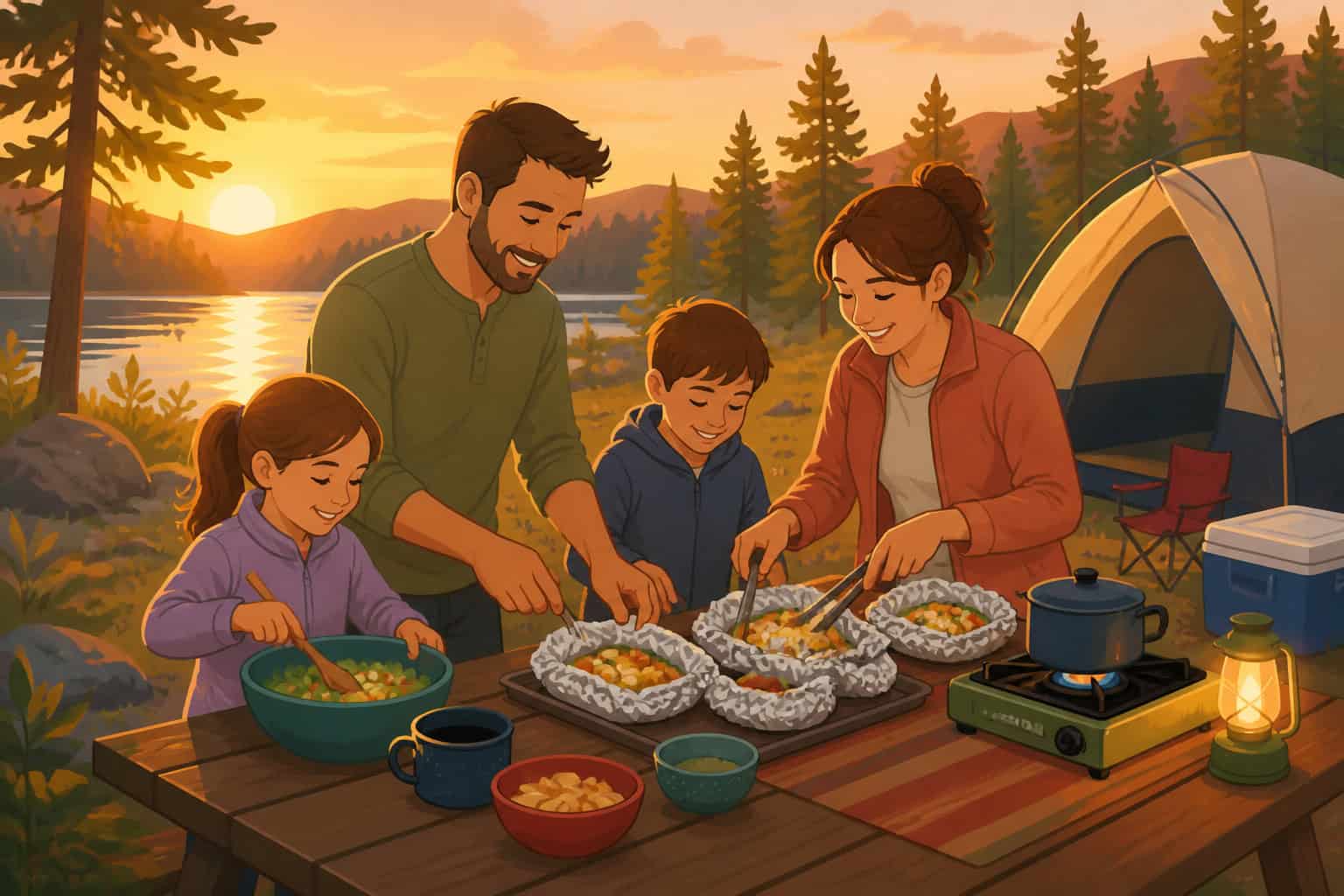
- Foil-pack breakfast hash with frozen shredded potatoes, peppers, and cooked sausage, sealed and set directly on the coals until the potatoes are tender
- A no-cook morning of yogurt cups, granola, and fruit packed the night before, for the days when everyone wants to get moving instead of eating
Lunch that survives being carried around
Camp lunches usually happen mid-hike or mid-activity, which means they need to hold up in a backpack for a few hours without turning into mush. Building lunch from separate components, assembled right before eating, solves most of that problem.
- Pita pockets with hummus, sliced cucumber, and shredded carrot packed separately and combined on the trail
- A sturdy cold noodle salad with vegetables that hold their texture, like bell pepper and snap peas, tossed in a vinaigrette that will not spoil quickly
- A simple lunch board of cheese, crackers, cured meat if your family eats it, and cut fruit, which needs no assembly at all beyond opening containers
Dinner that works with or without a good fire
Dinner is where camping trips either come together or fall apart, usually depending on whether the fire cooperates. It helps to have options for both a good fire night and a rained-out or burn-ban night when cooking over flame is not an option at all.
- A one-pot dinner on a camp stove, like a lentil and vegetable curry or a quick turkey chili, made mostly from pantry staples and prepped protein
- Foil-pack shrimp, corn, and smoked sausage with a pat of butter and old bay seasoning, sealed tight and cooked directly on coals for about fifteen minutes
- A no-fire backup dinner of cold rotisserie chicken, a bagged salad kit, bread, and cheese, fully assembled with zero cooking required for the nights when the weather or the fire ban decides for you
Snacks that hold up outside the cooler
Not every snack needs to compete for cooler space. Splitting snacks into shelf-stable and cooler-only categories keeps the cooler from overflowing and gives kids something to grab without asking.
- Shelf-stable: trail mix, dried fruit, whole-grain crackers, whole fruit like apples and oranges, and individual nut butter packets
- Cooler-only: cubed cheese, hummus cups, and cut vegetables, which spoil faster and need to stay cold
The short list of gear that actually earns its space
This is not the full camping gear checklist, just the cooking-specific items worth packing on purpose: a versatile pot or skillet, sturdy tongs, a sharp knife with a small cutting board, heavy-duty foil, a stack of resealable bags, a cooler with enough ice or frozen jugs to last the trip, reliable fire starters or a lighter, and a mesh bag for rinsing produce at a spigot or stream.
FAQs
How do I keep raw meat safe without a fridge?
Double-wrap or bag raw meat so juices cannot leak onto other food, and store it at the bottom of the cooler, below anything ready to eat, or in a separate cooler entirely. Cook it to a safe internal temperature: 160°F for ground meat, 165°F for poultry, and 145°F for whole cuts like steaks or chops.
What can we cook if campfires are banned?
A camp stove handles most of the same meals a fire would, from one-pot dinners to foil packets set directly on a burner instead of coals. It is also worth planning at least one no-cook dinner, like cold rotisserie chicken with a bagged salad and bread, so a fire ban does not mean an empty stomach.
How far ahead can I prep camping meals?
Anything frozen solid before you leave will generally hold through a short trip as long as it stays frozen or well chilled the whole time. Once something thaws, it follows the same rule as any other perishable food: safe for about two hours in the 40°F to 140°F danger zone, or one hour if it is 90°F or hotter outside.
What snacks keep well without a cooler?
Trail mix, dried fruit, whole-grain crackers, whole fruit like apples and oranges, and individual nut butter packets all hold up fine outside the cooler for a multi-day trip.