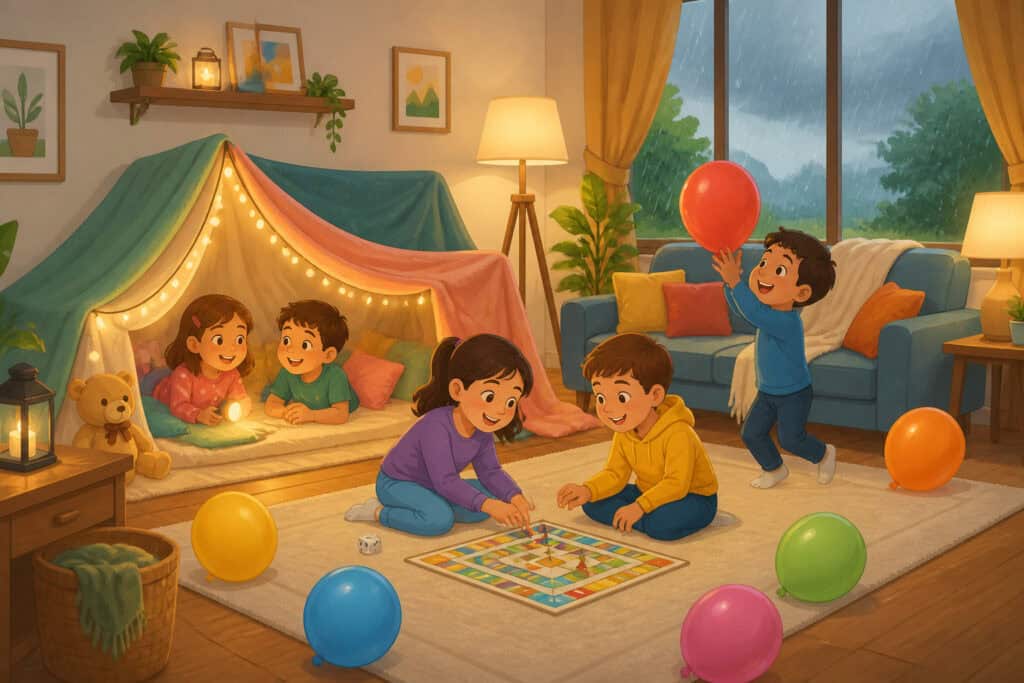
So you’ve got a small human with an attention span of a goldfish and a curiosity that could power a small city. Welcome to the glorious, chaotic world of kindergarten students activities. These kids are learning to read, count, share, and occasionally paint the dog. You don’t need a craft degree or an arsenal of fancy supplies to make their days rich and joyful.

Confession: sometimes we skip the ‘perfect’ AI images and just can’t resist picking the most awkward ones. Hopefully they bring a smile to your face too!
Also try: May Children’s Activities: 30 Playful Ideas
This post is written parent-to-parent: warm, a little cheeky, and practical. I’ll give you quick wins for car rides, circle time, rainy afternoons, and the five minutes before dinner when they need something that won’t end in glitter in your vacuum.
- This guide covers: quick circle-time warmups and games
- This guide covers: hands-on STEM, literacy, and art projects
- This guide covers: outdoor gross-motor activities and calming quiet-time ideas
- This guide covers: simple classroom/home management tips and a one-week sample plan
Why playful activities matter for kindergarten students
Play is the work of childhood. For kindergarten students, activities aren’t just about entertainment — they build language, fine motor skills, executive function, and social smarts. Plus, play teaches persistence: the glorious habit of trying again without crying into your latte.
Developmental wins
The right activity can hit multiple targets at once. For example, a counting hopscotch game supports: fine motor coordination, number sense, listening skills, and following multi-step directions. That’s efficient parenting.
- Language: songs, story retelling, and show-and-tell expand vocabulary
- Cognitive: sorting games and simple puzzles sharpen problem-solving
- Motor: cutting, beading, and movement games build fine and gross motor skills
- Social: turn-taking games teach cooperation and patience
Daily routine activities you can do anywhere
Morning circle: 10-minute rituals
Start with a predictable, two-part ritual: a hello song and a quick hands-on prompt. Keep it under ten minutes so attention doesn’t wander to something shiny.
- Hello song (name + action): “Hi Jamie! Wave your hands!”
- Weather check with picture cards: cloudy, sunny, rain — kids pick and explain
- One-question sharing: “Show me something that makes you happy”
Transition games (save your sanity)
Transitions are where small humans either blossom into calm citizens or start a dramatic production. Use quick structured activities to move smoothly between tasks.
- Freeze dance for tidy-up: music on, clean up until music stops
- Count-the-steps: stomp the number of steps to line up — practice counting
- Silent traffic light: red=freeze, yellow=whisper, green=sit
Hands-on literacy and math activities
Pocket story stones (5–10 min)
Materials: smooth stones or flat tokens, marker. Draw simple images: cat, tree, sun, house, boat. Keep them in a small pouch.
How to: Pull out three stones and ask the child to tell a short story using them. Prompt with who, where, and one problem. This supports narrative skills and sequencing.
Snack-math: counting that tastes good
Materials: small snacks (cheerios, grapes), paper plates with numbers.
How to: Call a number and have kids place that many snacks on their plate. Try adding and taking away a snack to introduce simple operations. Double-duty: practical life skills and math!
Simple STEM and sensory activities
Sink or float — predictable wonder
Materials: a clear tub of water, assorted small objects (spoon, leaf, toy car, cork).
How to: Have kids predict whether each object will sink or float. Test and chart results with stickers. Talk about why — introduces scientific thinking and vocabulary like “predict” and “observe.”
Building towers: balance & measurement
Materials: cardboard blocks, cups, or recycled boxes. Challenge kids to build the tallest tower that can hold a toy.
How to: Time trials, measurement with a simple ruler, and gentle competitions encourage engineering thinking and fine motor control.
Creations: art projects that won’t haunt you for weeks
Sticker mosaics (minimal mess, max pride)
Materials: dot stickers, construction paper, crayons.
How to: Give a shape outline (heart, star) and have kids fill it with stickers. Nice for fine motor practice, pattern work, and display-worthy art.
Salt-dough keepsakes (bake, paint, gift)
Materials: 1 cup flour, 1/2 cup salt, 1/2 cup water, cookie cutters.
How to: Mix, press into cutters, bake at low temp until hard, then paint. Turn drawings into ornaments or keepsakes. This also introduces following a recipe — a great life skill.
Outdoor and gross-motor movers
Nature scavenger hunt
Create a simple checklist: find a smooth rock, a yellow leaf, a feather, a pinecone. Pair kids up or make small groups. This sharpens observation and cooperative play.
Obstacle course: living-room or yard edition
Use cushions, tape lines, boxes, and hoops to make a short course. Add language prompts: “hop like a frog” or “crawl like a bear.” Great for energy release and following multi-step directions.
Calming activities and quiet-time strategies
Breathing buddies
Give each child a small stuffed animal to balance on their belly while they lie down. Use slow breaths in and out to make the toy rise and fall. Simple, portable, and surprisingly effective.
Story-lamp: guided wind-down
Dim lights, a soft lamp, and a short predictable story helps kids transition from high-energy play to quiet time. Have a repeatable phrase to cue winding down.
Practical tips: managing materials and behavior
Low-prep, high-return supplies
Keep a rotating basket of: dot markers, stickers, crayons, play dough, and index cards. Rotation keeps novelty high without needing a warehouse of supplies.
Behavior tips that actually work
Use short, specific language: not “be good” but “hands to yourself.” Offer choices to reduce power struggles: “Do you want blue or red paper?” Positive reinforcement beats repeating no 37 times.
A one-week sample plan for busy parents
Here’s a compact plan you can adapt. Each activity is 15–25 minutes and uses low-cost supplies.
- Monday: Pocket story stones + outdoor scavenger walk
- Tuesday: Sticker mosaics + obstacle course
- Wednesday: Sink or float experiment + rhythm clapping games
- Thursday: Snack-math + building towers challenge
- Friday: Salt-dough shapes + show-and-tell gallery
Quick adaptations and inclusion tips
Not every activity fits every child. Here are simple ways to adapt so all kids thrive.
- Reduce steps: give one clear instruction at a time
- Offer sensory options: soft brush, noise-reducing headphones, tactile trays
- Differentiate materials: larger beads for fine-motor challenges, visual choice boards for nonverbal kids
Final notes for parents and teachers
The goal of kindergarten students activities isn’t perfect pinterest photos or quiet classrooms by force. It’s curiosity, connection, and the small wins that add up — a child who counts confidently, a friend who learns to wait, a shy kid who shares once.
Pick a handful of favorites from here, tweak them to fit your schedule, and rotate. Keep instructions short, celebrate effort loudly, and remember: messes are temporary, memories aren’t.
FAQs
What are easy kindergarten students activities for a short attention span?
Choose 10–15 minute activities like pocket story stones, sticker mosaics, or quick movement games (freeze dance, hopscotch). Keep supplies ready and give one simple instruction at a time.
How can I use kindergarten students activities to build early math skills?
Use snack-math for counting, sorting games for grouping and sets, and simple measurement during building activities. Turn play into math talk: ask “how many,” “more or less,” and “how tall?”
What outdoor kindergarten students activities are best for gross motor development?
Obstacle courses, nature scavenger hunts, and ball games (catch, kick) build balance, coordination, and spatial awareness. Keep courses short and add language cues for sequencing.
How do I adapt kindergarten students activities for children with different needs?
Simplify steps, provide visual choices, use larger or textured materials, and allow extra time. Offer sensory-friendly options and pair children with supportive buddies for social tasks.
Can these kindergarten students activities be used at home and in the classroom?
Yes. Most activities are low-prep and scaleable. At home, use smaller groups and household materials; in the classroom, rotate stations and add a simple recording sheet for assessment.