A car seat is the one piece of baby gear that refuses to be reasonable. It does not fold flat, it does not have wheels of its own, and it usually takes both hands to carry, which is a problem when you also have a diaper bag, a rolling suitcase, and a small person who wants to be picked up right now. If you are standing in your living room wondering how you are supposed to get a car seat from curbside check-in to a rental car three states away without losing your mind, the practical answer is to pick one of a handful of proven methods, match it to your child’s age and how much other gear you are hauling, and know before you reach security what your airline will actually let you do with it.
Why the car seat is the hardest thing to carry
Most travel gear is designed to be portable. Car seats are not. A typical infant seat runs 8 to 12 pounds before you add a base or a canopy, and a convertible or toddler seat can push past 20 pounds with an awkward, wide-bottomed shape that does not sit comfortably against a hip or under an arm. Add a diaper bag, a stroller, and one or two kids who need a hand to hold, and the car seat becomes the item that never has a free limb assigned to it. Most of the real difficulty of flying with a car seat is solved before you ever reach the gate, by choosing the right way to move it through the terminal in the first place.
First, decide what you are actually doing with the car seat
How you carry the car seat depends on what happens to it once you reach the plane, so it helps to settle that question first.
- Checking it at the ticket counter: the seat becomes checked baggage from the start. This is free on essentially every major U.S. airline, but you lose the car seat’s usefulness as a stroller or gear-hauling aid for the rest of the terminal, and it travels unattended through the same handling as regular luggage.
- Gate-checking it: you keep the car seat with you through security, the gate area, and boarding, then hand it off at the jet bridge door right before stepping onto the plane. It is returned at the jet bridge on arrival for most domestic flights, or at baggage claim on larger aircraft. This is also free, whether or not you bought your child a seat, and it is the option most parents traveling with an infant or toddler actually use.
- Using it onboard: this only works if you purchased a seat for your child, or an adjoining seat happens to be empty, and only with a car seat labeled as approved for aircraft use. You carry it on, install it in the aircraft seat, and it flies with your child instead of in the cargo hold.
Most families flying with a lap infant or a young toddler carry the car seat through the terminal and gate-check it. That keeps it out of standard checked luggage, where a mishandled bag or a long connection can mean arriving at your destination without a place to safely buckle in your child. For more on managing everything else in the diaper bag along the way, our guide to flying with a toddler covers the rest of the packing and boarding routine.
The practical ways to actually carry it through the terminal
None of these require special skill, just matching the tool to the seat and the situation.
- Carry it by the built-in handle or an over-the-shoulder strap. This works fine for short walks and for lighter infant seats, especially inexpensive travel-friendly models that weigh well under 15 pounds.
- Clip-on backpack straps that turn a seat’s carry handle into shoulder straps, freeing both hands for a child or a bag. Several brands sell these as standalone accessories that attach to almost any seat.
- A padded car seat travel bag, sometimes marketed as a car seat carrier for airport use, zips over the entire seat and usually adds its own backpack straps or wheels. It protects the seat from scuffs and impacts if it is going to be checked or gate-checked, which matters more for an expensive seat than an inexpensive one.
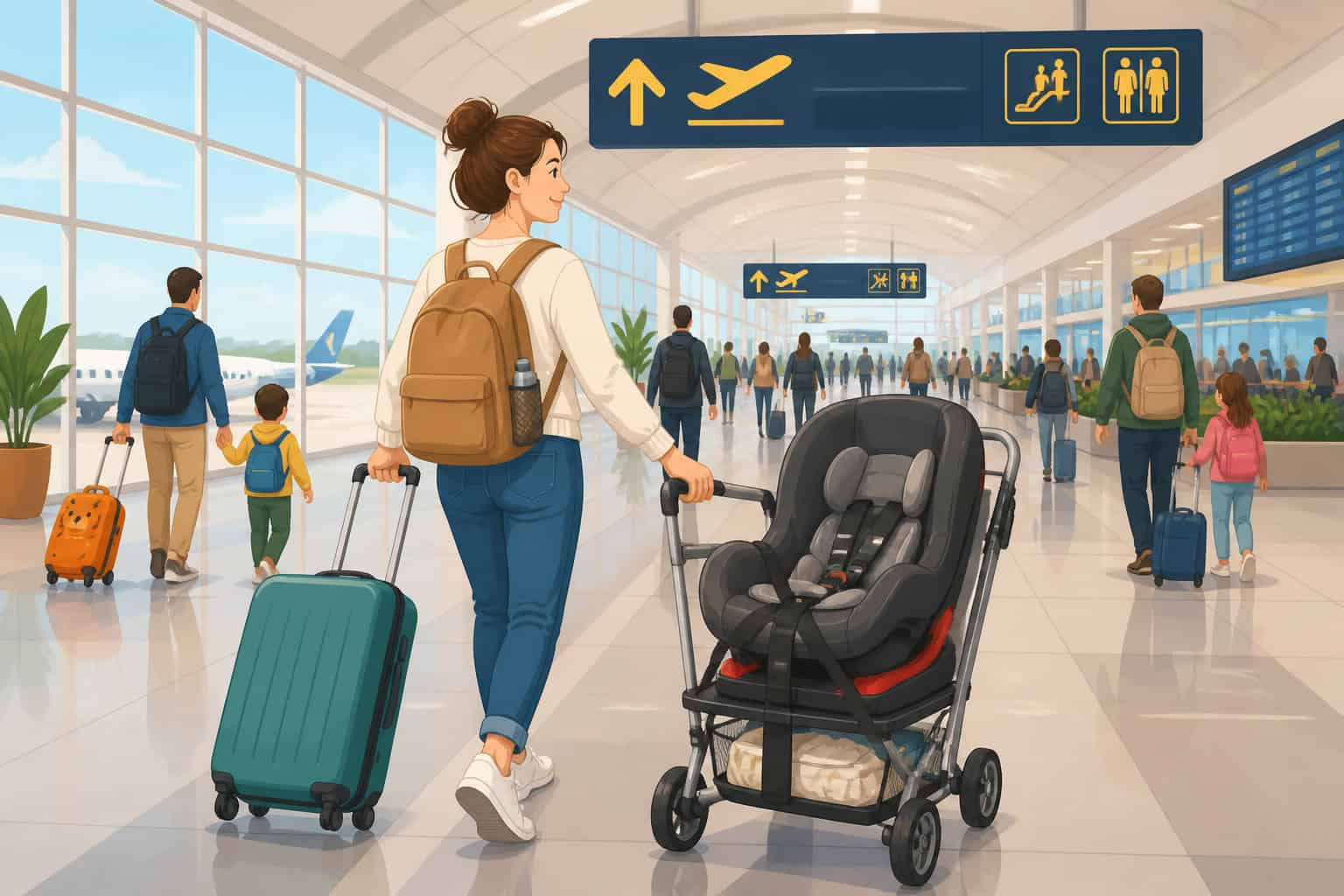
- A wheeled travel cart or dolly straps the car seat to a small folding platform, turning it into something you push or roll like a piece of luggage. This tends to make the biggest difference for bulkier convertible or toddler seats that are awkward to lift and carry for any distance.
- Strapping the seat directly onto a rolling suitcase, using the compression straps built into some travel bags, so one hand can push both at once.
- A stroller-compatible travel system, where an infant seat clicks directly onto a matching stroller frame. You wheel the seat, with or without the baby in it, through the whole terminal and gate-check the stroller and seat together at the door.
Plenty of families combine two of these: a stroller travel system to the gate, for example, followed by gate-checking both the stroller and the seat there. Which combination works best usually comes down to how many hands you have free and how far you are walking.
What actually happens at security
You can bring the car seat right up to the checkpoint. It goes through the X-ray machine like any other carry-on item, while your child walks or is carried through the metal detector separately, since the seat cannot go through with them inside it. Detaching easily removable pieces beforehand, such as a cup holder or a toy bar, tends to speed up screening and keeps small parts from getting lost on a crowded conveyor belt. TSA does not restrict which car seats you can bring through the checkpoint; the rules about which seats are allowed onboard the aircraft itself come from the FAA, not from security screening.
Choosing a method based on age, seat size, and how much else you are carrying
For a young infant in a lightweight bucket seat, hand-carrying or a stroller-compatible travel system usually covers it, especially if you are also wearing the baby in a carrier while the empty seat rides on the stroller frame. For a bulkier convertible or toddler seat, a wheeled travel cart or a padded bag with backpack straps makes a much bigger difference, particularly if you are traveling solo with more than one child. If you also have a stroller in the mix, look for a cart or strap system built to handle both at once rather than trying to carry each separately. And if you have bought your child their own seat and plan to use the car seat onboard, the carrying method matters less than timing: roll or carry it to the gate, then use family pre-boarding if it is offered so you have a few extra minutes to install it before the rest of the plane boards. For the rest of the airport routine, from security prep to boarding order, our practical tips for flying with kids covers it.
A few things that make the whole process smoother
- An inexpensive, lightweight travel seat reduces the stress of gate-checking without a protective bag, since there is less to damage and less to worry about financially if it comes back scuffed.
- Label the seat with your name and phone number the same way you would label a stroller, so it is easy to identify if it gets separated from you at the jet bridge.
- Ask about family pre-boarding if you plan to install the seat onboard. Most major carriers offer it, and it buys a few unhurried minutes before the aisle fills up.
- If you are using the seat onboard, check its width against your specific aircraft type ahead of time. Standard coach seats generally fit car seats up to about 16 inches wide, but some aircraft and airlines run narrower, so it is worth a quick check rather than finding out at the gate.
FAQs
Is it free to check a car seat at the airport?
Yes. Every major U.S. airline allows one car seat per child to be checked at no charge, either at the ticket counter or at the gate, separate from your regular checked baggage allowance.
Do I need a special bag to carry a car seat through the airport?
No, it is not required. A padded travel bag protects the seat from scuffs and impacts if it is going to be checked or gate-checked, which matters more for an expensive seat than an inexpensive one, but plenty of parents gate-check a seat with no bag at all.
Will TSA make me take my child out of the car seat at security?
Your child needs to walk or be carried through the metal detector separately, since the seat itself goes through the X-ray machine like any other carry-on item. TSA does not restrict which car seats you can bring to the checkpoint.
Can I use any car seat on the plane?
Only a child restraint system approved for aircraft use and labeled accordingly. Install it according to the manufacturer’s instructions, including whether it should face forward or rearward for your child’s size. A window seat is generally preferred so the car seat does not block another passenger’s path to the aisle, and it cannot be placed where it would interfere with emergency egress. Check your airline’s seating rules before you fly.