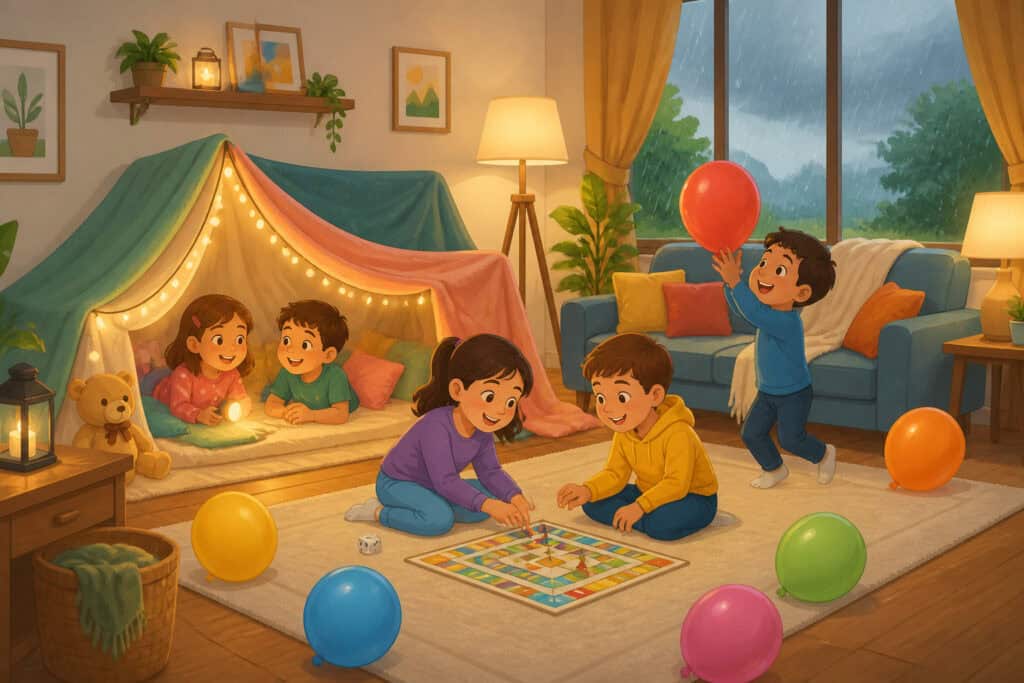
Games for 5-Year-Olds: quick wins and grown-up sanity
If you’ve ever promised your child “just one game” and emerged an hour later with glitter in your coffee, welcome to parenting. Children at five are a brilliant mix of curiosity, boundless energy, and a developing attention span, which means the best games are short, clear, and just challenging enough to feel like an achievement.

Confession: sometimes we skip the ‘perfect’ AI images and just can’t resist picking the most awkward ones. Hopefully they bring a smile to your face too!
Also try: Great Activities for 3 Year Olds: Fun, Simple Ideas
This post looks at easy setups, educational spins, outdoor classics, and low-prep DIY games that work whether you have one child, a playdate, or a rowdy birthday crowd. I’ll also include helpful variations so you can scale difficulty or calm things down.
- This guide covers quick indoor games, outdoor active ideas, quiet/learning activities, and DIY sensory options.
- Step-by-step instructions and variations for each game.
- Safety tips, cleanup tricks, and how to keep the attention of a five-year-old.
Quick wins: 8 easy games to start today
1. Treasure Hunt (Indoor or Backyard)
A treasure hunt uses what you already have and turns five minutes into a thrilling mission. It’s perfect for developing problem-solving and following directions.
- Prep: hide 6–10 small items (toys, socks, stickers).
- Clues: use picture clues or simple rhymes for five-year-olds.
- Play: give the first clue and let them solve the next spot; praise every find.
Variations: timed hunts for older kids, color-only hunts for early readers, or make a map for a pirate theme.
2. Freeze Dance
A classic active game that teaches listening and self-control. Great for indoor energy-burning when going outside isn’t an option.
- Play lively music and let kids dance freely.
- When the music stops, everyone freezes—any movement is out for one quick funny penalty (like a silly pose).
- Repeat, shortening dance time to up the challenge.
Variation: use theme playlists (jungle, space, or favorite movie songs). For quieter play, try ‘statue’ where they hold a pose for five breaths.
3. Sock Toss (Indoor Ring Toss)
Low-prep, safe, and perfect for teaching aim and turn-taking. All you need: rolled-up socks and a basket or hula hoop.
- Roll socks into balls and mark a throwing line.
- Assign point values to baskets or hoops at different distances.
- Take turns; keep score or play cooperatively to reach a combined target.
Make it educational by asking the child to add numbers for a simple math practice or by calling colors for each throw.
4. Mini Obstacle Course
Kids this age love a challenge that feels grown-up. An obstacle course builds gross motor skills and planning.
- Use cushions, taped lines, tunnels (cardboard boxes), and cones.
- Set a sequence: crawl under, hop over, zigzag, and slide finish.
- Time a run for excitement or play cooperatively to beat your own record.
Safety note: soft landings and clear walkways prevent tumbles. Adapt difficulty to fit your space and the child’s confidence.
5. I Spy (With a Twist)
I Spy is timeless for language and observation skills. For five-year-olds, add a challenge that matches their reading level or interests.
- Standard play: ‘I spy with my little eye, something that is…’.
- Variation: use letters — ‘I spy something that starts with B’.
- Advanced: give two clues (color and shape) or a short riddle.
6. Story Dice
Roll dice with pictures (store-bought or homemade) to spark creativity and narrative skills. Five-year-olds can link images into short stories.
- Make 6–12 picture dice using paper and small cubes or draw cards.
- Each roll adds a new element to the shared story.
- Encourage descriptive words and ask follow-up questions.
Variation: have the child act out one part of the story for extra movement and drama.
7. Simon Says
This classic builds listening skills and body awareness. It’s easy to make the commands educational or silly.
- Leader gives commands prefaced by ‘Simon says’.
- If the leader omits ‘Simon says’ and someone follows, they’re out for a gentle penalty.
- Use actions that practice counting, colors, or animal movements.
Tip: rotate who gets to be ‘Simon’ so kids practice leading and following.
8. Nature Scavenger Hunt
Perfect for outdoors: a list of leaves, stones, bugs, or cloud shapes keeps kids exploring and noticing details.
- Prepare a simple checklist with pictures for non-readers.
- Set boundaries and a time limit for safety.
- Optional: have them sketch one find or stick a leaf in a notebook.
Quiet and educational games that sneak in learning
Not every game needs to be energetic. Quiet play builds focus, fine motor skills, and early literacy—exactly what games for 5-year-olds should do when you need calm.
Puzzle Swap
Set a timer for 10 minutes and have the child work on a puzzle. When time’s up, rotate to a new puzzle. It keeps interest high and gives multiple small wins.
Memory Match — with a twist
Use cards with numbers, letters, or sight words. Each match must be read aloud or used in a sentence, reinforcing skills through play.
Outdoor and group games that really move the wiggles
Five-year-olds thrive in the fresh air. These games use larger spaces and encourage cooperative play—great for parks or backyards.
Relay Races (teamwork edition)
Simple relays can include egg-and-spoon, balancing a beanbag, or carrying an item between teammates. Add cooperative tasks like assembling a puzzle as a team finish.
Bubble Chase
Run, pop, giggle. Blow big bubbles and let kids chase or try to catch them with hands or nets. It’s pure joyful chaos.
DIY, sensory, and cheap games
You don’t need fancy toys. Sensory play helps regulation, and homemade games are wallet-friendly.
Sensory Bin Bingo
Fill a bin with rice, pasta, or water beads and hide small toys. Give the child a bingo card of items to find. It quiets and focuses them, and you control the mess level.
Homemade Board Game
Draw a path on cardboard, use buttons as markers, and roll a dice. Add picture challenges on certain squares (sing, hop, name a color) for variety.
Tips for success, focus, and cleanup
Five-year-olds respond to clear rules, short rounds, and routines. Here are practical parenting tricks that make game time actually relaxing.
- Keep rounds short: 5–10 minutes fits a typical attention span.
- Use positive rules: tell them what to do, not just what not to do.
- Rotate toys and games weekly to keep novelty high.
- Include a tidy-up song and a simple reward (sticker, sticker, or extra story).
- Adapt difficulty by adding or removing steps—games should feel winnable.
If a game isn’t working, switch to a quieter option or introduce a cooperative rule so no one ‘loses’ for long. Remember: the goal is connection and learning, not perfect gameplay.
Wrap-up: pick one, play now
Games for 5-year-olds are about movement, imagination, and small victories. Pick a game that matches your energy level, tweak a rule or two, and let the fun begin.
Save this list for a rainy day—or keep a printed copy on the fridge. When five-year-old enthusiasm hits, you’ll be ready with ideas that build skills and buy you a few peaceful minutes.
FAQs
What are easy games for 5-year-olds that burn energy indoors?
Try Freeze Dance, a Mini Obstacle Course, or Simon Says with big movements. These require minimal setup and let kids run off energy safely inside.
Which games for 5-year-olds help with reading and language skills?
I Spy with letter clues, Story Dice, and Memory Match using sight words all boost vocabulary and phonics in playful ways.
How long should a game session be for a five-year-old?
Keep rounds to 5–15 minutes depending on the game’s activity level. Short rounds with clear endings suit their attention span and prevent meltdowns.
Are sensory games good for five-year-olds and how messy are they?
Yes—sensory bins and simple crafts help regulation and fine motor skills. Control mess by using trays, washable materials, and supervised setups like rice in a bin or water play outdoors.